EP 1607: TRUMP NUKES SOMALIA??? Trump GOES OFF On Somalia, Imposes New Travel Ban
December 2, 2025 | Tuesday
Tags: elon-musk, jd-vance, donald-trump
President Trump unleashed a profanity-laced denunciation of Somali immigrants during a cabinet meeting and his administration promptly paused immigration processing for nationals of 19 countries. Elon Musk’s remark that “Jews are white” sparked a broader debate over Jewish identity, historical experience, and the political influence of prominent Jewish figures.
ARTICLES
- NYT: Trump Calls Somalis ‘Garbage’ He Doesn’t Want in the Country
- TRUMP ON TRUTH: “Refugees from Somalia are completely taking over the once great State of Minnesota”
- U.S. Pauses Immigration Applications From Nations on Travel Ban List
TRUMP AND SOMALIA
President Trump’s abrupt, profanity‑laced denunciation of Somali immigrants during a Tuesday cabinet meeting was captured on video and amplified by a same‑day policy shift: a pause on a range of immigration benefits and processing for nationals of 19 countries. Video shows Trump apparently dozing in the meeting, rousing himself, and delivering a visceral denunciation of Somali migrants and Representative Ilhan Omar, using terms the administration and its allies described as blunt and unapologetic. Press secretary Carolyn Levitt publicly characterized the exchange as an “epic moment.” Within hours, U.S. Citizenship and Immigration Services began pausing green card processing, naturalization interviews, and other forms of status adjudication for nationals from a list that officials and reporting identify to include Afghanistan, Iran, Libya, Myanmar, Eritrea, Cuba, Haiti, Chad, Sudan, Yemen, Laos, Venezuela, Sierra Leone, Togo, Burundi, the Republic of Congo, Equatorial Guinea, Turkmenistan and Somalia. Immigration lawyers reported cancelled naturalization ceremonies and turned‑away interviewees on the same day the pause was implemented.
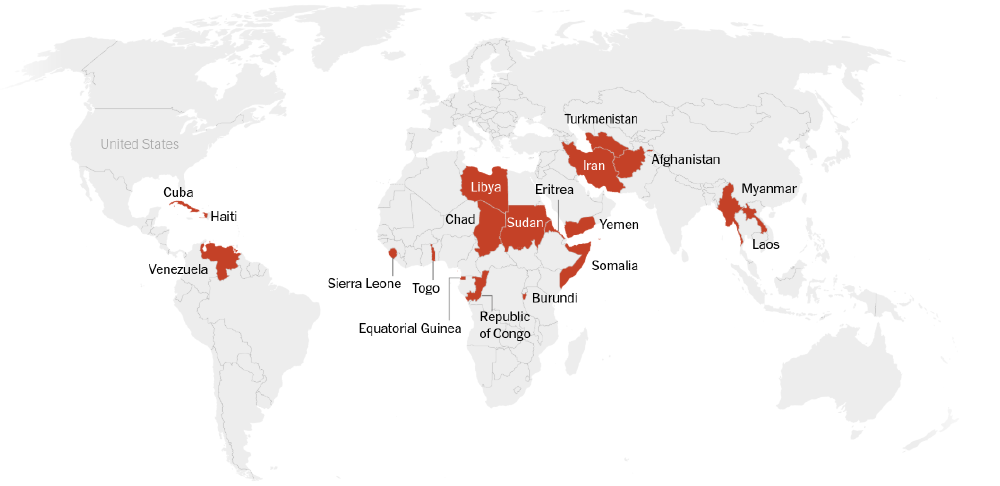
Countries subject to a pause on U.S. immigration applications (NYT)
The pause applies to multiple bureaucratic tracks. According to agency officials and contemporaneous reporting, the action halted adjudication of adjustment of status applications, naturalization interviews and some interview scheduling for lawful permanent resident processing for people from the listed countries. Administration statements framed the measure as an extension of earlier travel restrictions announced in June that targeted some of the same countries. Government officials cited recent violent incidents, notably the shooting of two National Guard members in Washington, as the proximate catalyst for intensifying immigration rhetoric and policy. The juxtaposition of the on‑camera tirade and the administrative pause signals a coordinated messaging operation: publicized harsh rhetoric followed by visible regulatory action to satisfy political constituencies demanding tougher immigration measures.
A dispassionate examination of the list and of migratory flows shows a clear mismatch between symbolic headline politics and the material flows that drive migration patterns. The 19 countries on the pause list are, with few exceptions, among the poorest and most politically unstable in the world. That is real and consequential for asylum adjudication. The practical effect of pausing processing for citizens of Equatorial Guinea, Togo and the Republic of Congo is, however, limited when compared with the largest sources of recent immigration to the United States. Mexico, India, China, El Salvador, Guatemala, Honduras, the Philippines and other nations supply the bulk of flows and border arrivals. In the administration’s own public comments over the last month, it has discussed the need for 600,000 foreign students and roughly 120,000 H‑1B workers each year. Those specific numbers underscore a durable political tradeoff: performative crackdowns on a small set of countries while preserving avenues for high‑skilled and high‑revenue migration that donors and business interests favor.
The policy and the rhetoric together show how political calculus shapes immigration enforcement strategy. A narrow travel‑pause of 19 low‑volume sending countries can be presented as decisive action without altering the larger structural drivers of migration. Genuine reduction in immigrant populations resident in U.S. cities would require large scale removal operations, employer sanctions, an uncompromised E‑Verify system with enforcement that closes known loopholes, and a sustained detention and removal capacity far beyond a symbolic pause on applications. If the objective is to materially change the demographic and geographic distribution of immigrant communities in places like Minneapolis or Dearborn, the United States would need to pursue deportations on a scale measured in hundreds of thousands to millions, combined with employer penalties in the five thousand to fifteen thousand dollar range per illegal hire and real interagency coordination to process removals and repatriations. Without those concrete operational steps, the current package of rhetoric plus a selective pause will be experienced by many voters as theatrical and likely reversible, satisfying a short political cycle but producing little durable change in the composition of American cities.
My analysis concludes that the administration has returned to highly visible nativist rhetoric at a moment of political vulnerability, then paired that rhetoric with limited regulatory steps calibrated to maximize political effect while minimizing cost to donor constituencies. That combination buys time and mobilizes supporters without delivering the structural reforms necessary to realize the broad immigration moratorium invoked in rhetoric. Genuine, lasting change will require either a comprehensive admissions moratorium applied across all countries or a sustained program of interior enforcement tied to employer sanctions and judicial reform to overcome injunctions. Anything short of those operational commitments will leave the headline victory intact but the on‑the‑ground status quo substantially unchanged.
ELON AND JEWISH IDENTITY
Elon Musk’s Twitter exchange in which he asserted “Jews are white. They’re actually the peak whites in the world, peak white” served as the immediate spark for a much larger argument about Jewish identity, historical placement and political allegiance. Musk’s follow up comments argued that visual phenotype and genetic similarity justified labeling Jews as white. Critics and interlocutors pushed back, saying Jews do not self‑identify as European and must be understood as a distinct ethnoreligious people. The exchange catalyzed a comprehensive critique that traces Jewish history across expulsions from medieval and early modern Europe, centuries in the Pale of Settlement, pogroms across Eastern Europe, and the eventual political project of Zionism that established a Jewish nation state outside of Europe. Those historical touchstones are deployed to argue that Jewish civilization has never been fully coterminous with European Christendom and that policy and political alignments should reflect that distinction.
The argument advanced here is twofold and unapologetic in its claims. One strand holds that “white” as a political and civilizational category means European origin and that phenotype alone is insufficient for membership in that category. The second strand contends that Jewish elites and institutions have over the modern era acted as a distinct political force that does not consistently align with the policy interests of European‑descended Christian majorities. The speaker marshaled a long list of named figures to illustrate factional behavior in elite networks, naming financiers, media personalities and Silicon Valley donors as actors who exercise outsized influence over political narratives and donor flows. Examples presented included PayPal‑era entrepreneurs and public intellectuals who serve as political funders and influencers. The speaker framed those relationships as structural elements that explain Republican deference in areas such as foreign policy, criminal law, and immigration.
Understanding the political dynamics at play requires acknowledging the concrete institutions and moments cited. The World Jewish Congress, meetings of major Jewish philanthropists, and repeat diplomatic interactions between Israel and senior U.S. officials are not abstract phenomena. They are networks that raise money, lobby legislatures, and shape public debates over anti‑Semitism legislation, university governance, and U.S. foreign policy in the Middle East. The speaker asserts that conservative Jews who publicly champion a Judeo‑Christian fusion of values simultaneously act in ways that, historically and politically, diverge from the national‑majority interests the speaker claims should be prioritized. That perceived divergence becomes a political problem of coalition discipline: if donors and elite communicators advance policies—immigration patterns, litigation strategies, or cultural priorities—that appear to run counter to the stated interests of a European‑descended conservative base, frustration and factionalism follow.
My analytic assessment is that this framing converts longstanding cultural and historical disagreements into a contemporary political cleavage with measurable consequences. If Jewishness is treated as a distinct political category rather than a component of an inclusive Western identity, then appeals to “Judeo‑Christian civilization” no longer hold the same mobilizing power across a broad coalition. The practical effect is to force clearer alignment choices by elected officials and to place particular pressure on party elites and donor networks. That pressure can be wielded in the short term by withholding political support, making endorsement contingent on explicit immigration and cultural policies, and demanding transparency about donor influence. The speaker’s recommended strategy is explicit and operational: rebuild political solidarity along what are defined as racial and civilizational lines, make policy demands nonnegotiable, and treat performative gestures as insufficient. Those steps will provoke counter‑reactions from establishment institutions and invite charges of bigotry. The speaker accepts that outcome as the logical price of reconstituting a political movement that treats European identity and interests as primary and nontransferable.